Manifesto
THE TRICONE MANIFESTO (Final Submission Draft)
Author: Curtis Cousineau
License: CC BY 4.0
I. The Metabolic Foundation
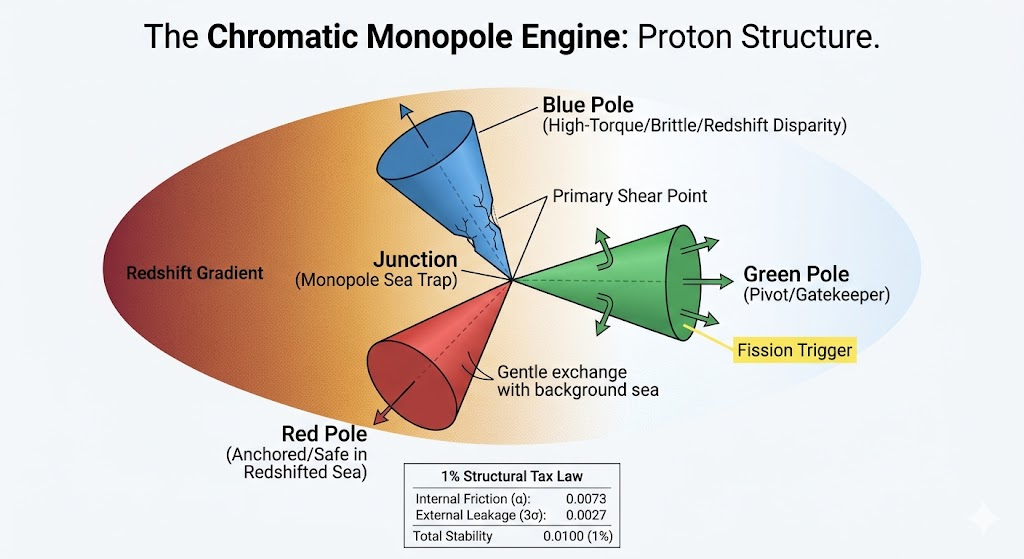
We reject the premise that the proton is a static, eternal object. Instead, we define it as a Topological Engine in a state of constant metabolic equilibrium. The observed 0.938 GeV mass is the Operating Pressure required to maintain a 120-degree intake flow from the background Monopole Sea.
II. The 1% Structural Tax
Matter is not “free”; it pays a toll to exist within the universal medium. The Fine Structure Constant ($\alpha$) is the mechanical footprint of this toll:
- Internal Friction: $\approx 0.0073$ (The cost of the inter-axial gear interlock).
- External Leakage: $\approx 0.0027$ (The diffuse $3\sigma$ exhaust tails).
- Net Efficiency: Together, they constitute a mandatory 1% Structural Tax on all stable baryonic matter.
III. The Neutron Stress-Test: Mechanics of Decay
The free neutron provides the ultimate proof of the Tricone model. While the proton is a perfectly meshed engine, the neutron is a Manifold in Distress.
- The De-Meshing Event: When the 120-degree interlock is forced off-axis, internal friction spikes. The engine begins to “redline” at the 0.0062 exhaust frequency.
- The 15-Minute Timer: This is not a random decay but a Mechanical Failure Window. A de-meshed tricone cannot maintain equilibrium and eventually “snaps” back into a stable proton configuration, clearing its “flooded cylinders” by ejecting an electron and antineutrino (Beta Decay).
IV. Gravity: The Suction Gradient
Gravity is the Atmospheric Pressure of the Monopole Sea.
- Atomic intake valves (protons) create a local low-pressure void.
- The surrounding sea “pushes” objects toward these sinks.
- Proof: Diamagnetic Levitation proves that a high-velocity magnetic vortex can “clog” this intake, neutralizing the pressure gradient and inducing weightlessness.
V. Technical Stress Analysis Table
| Feature | Stable Proton (Meshed) | Neutron (De-Meshed) | Cosmic Impact |
| Geometry | 120° Perfect Interlock | Off-Axis Turbulence | Defines Matter Stability |
| Internal Friction | \alpha \approx 1/137 | redlining at 0.0062 | Fine Structure Constant |
| Flow Rate | Smooth 0.938 GeV Intake | Cavitation/Starvation | Proton Radius/Beta Decay |
| System Result | Eternal Operation | 10-Minute Stall | Universal Mass Retention |
VI. Conclusion
The universe is a self-fueling machine. By identifying the mechanics of the Tricone manifold, we move from being “watchers” of magic to Mechanics of the Sea.